
Three Projects.One Live Corridor.
Around 640 km² across New South Wales and Western Australia. Peak View carries the drill rig and the near-term catalyst. Black Hammer and Deep Dykes carry targets that modern exploration has never touched.
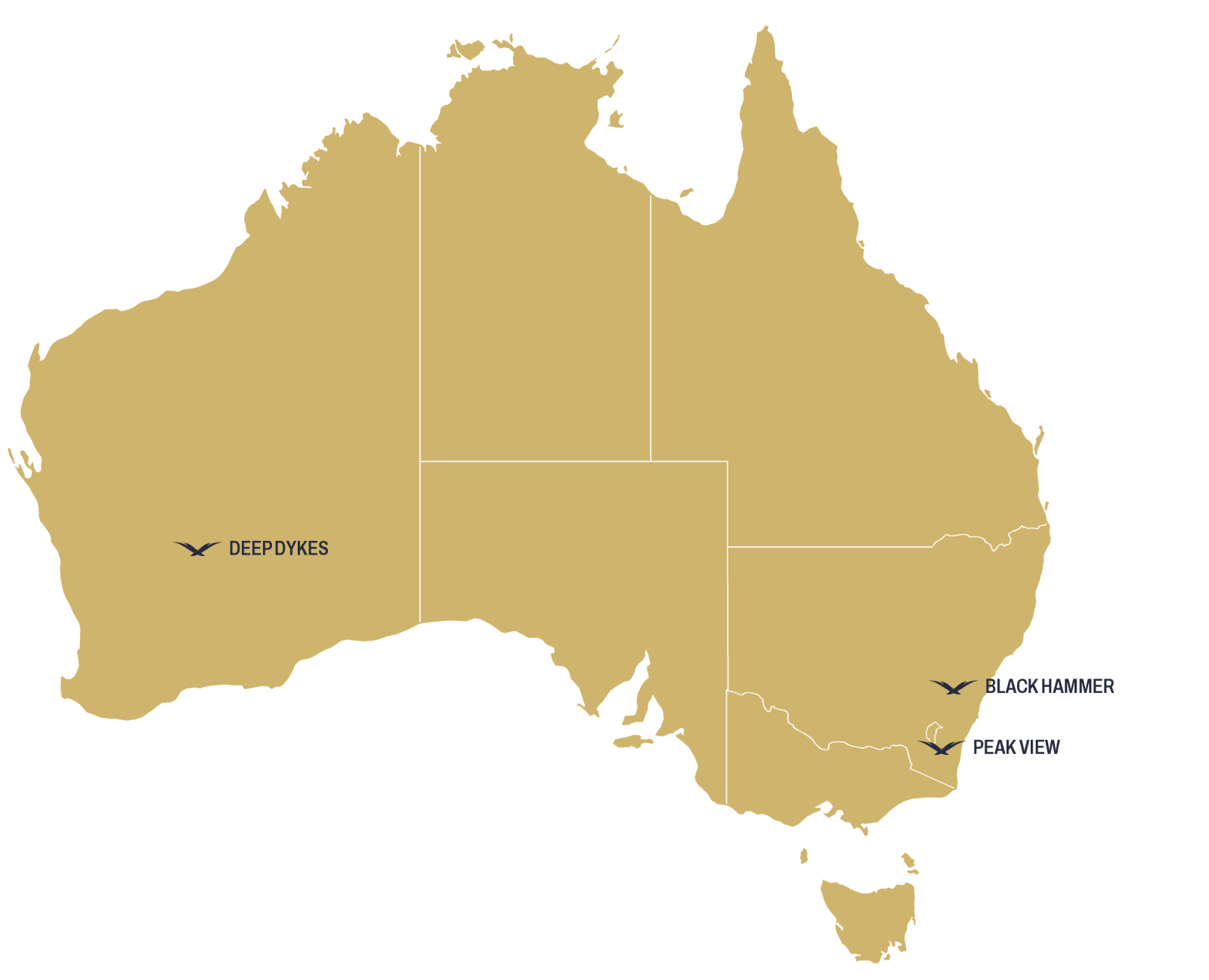
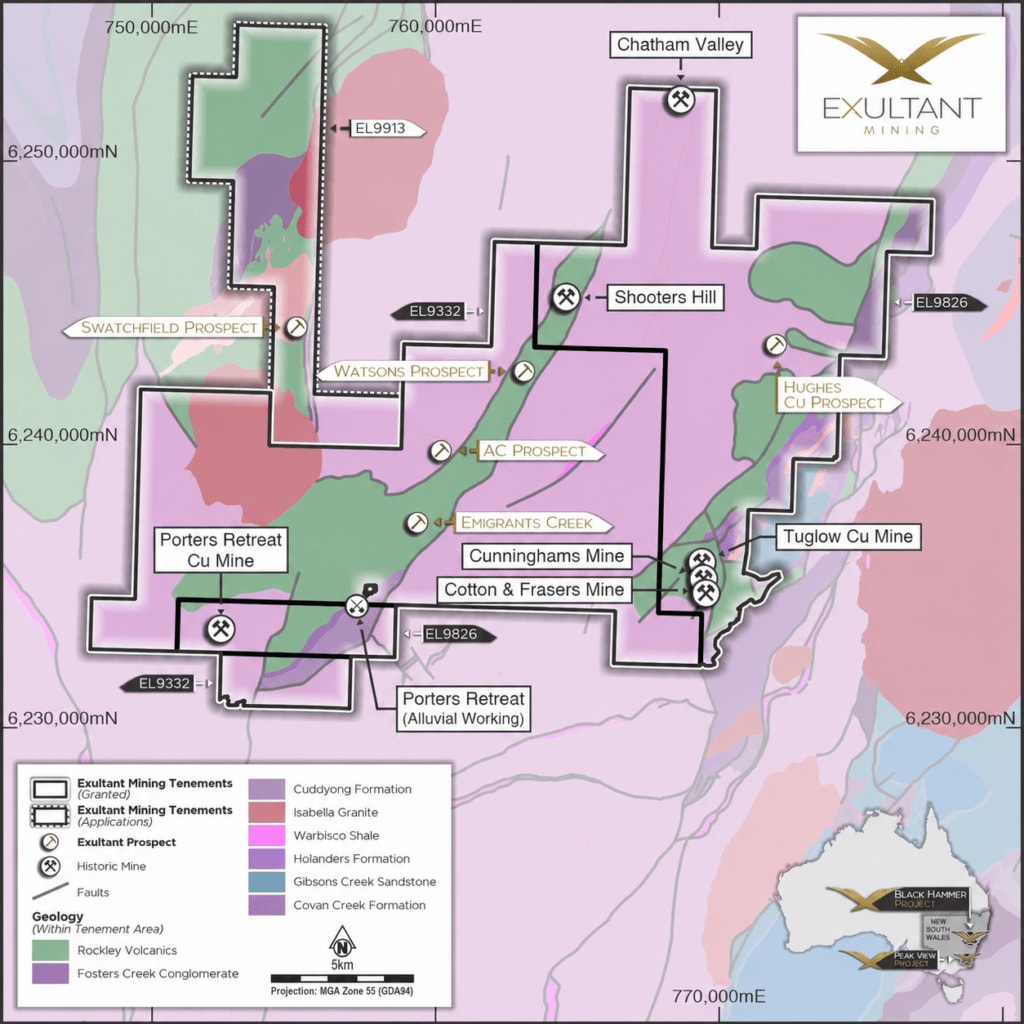
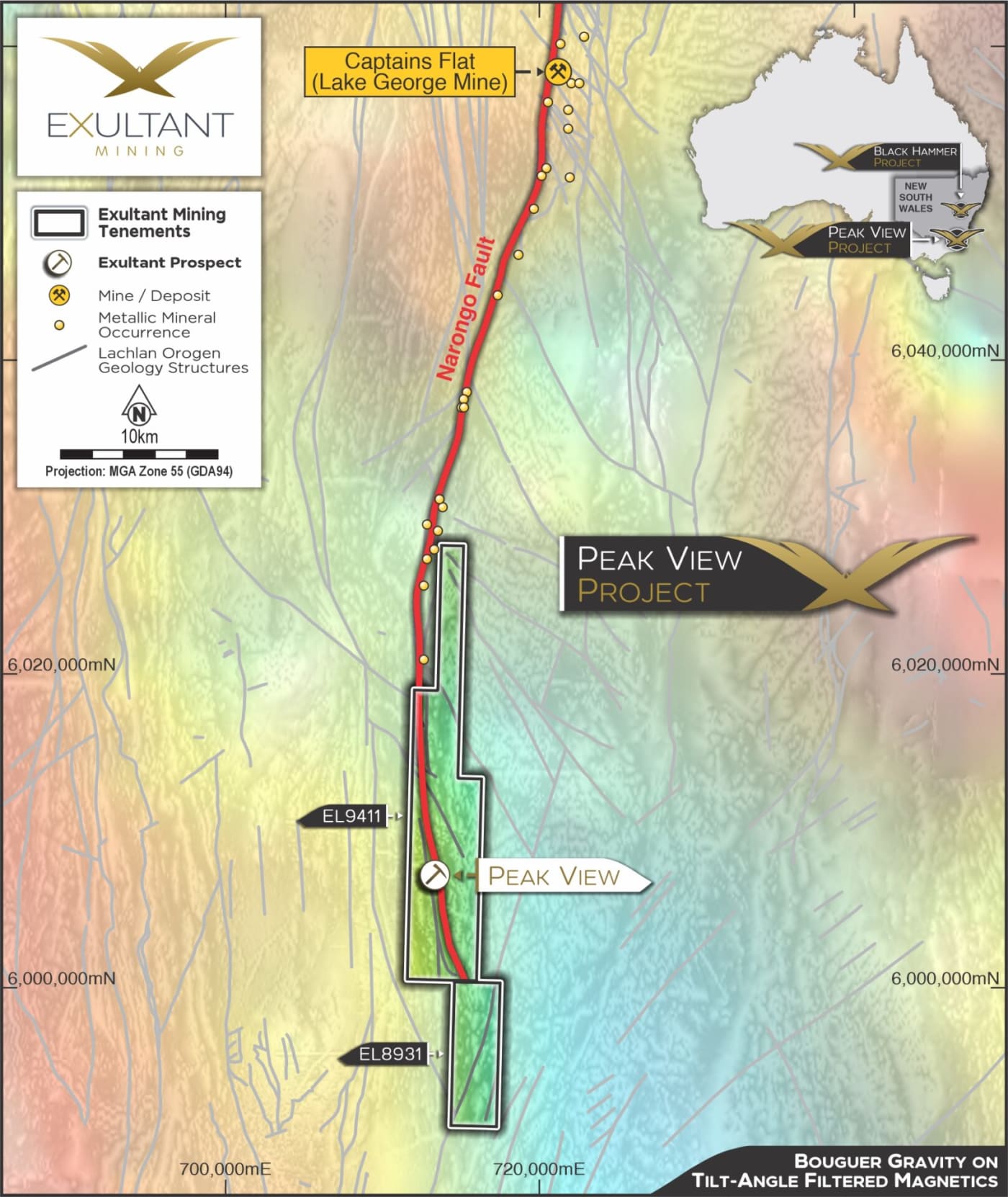
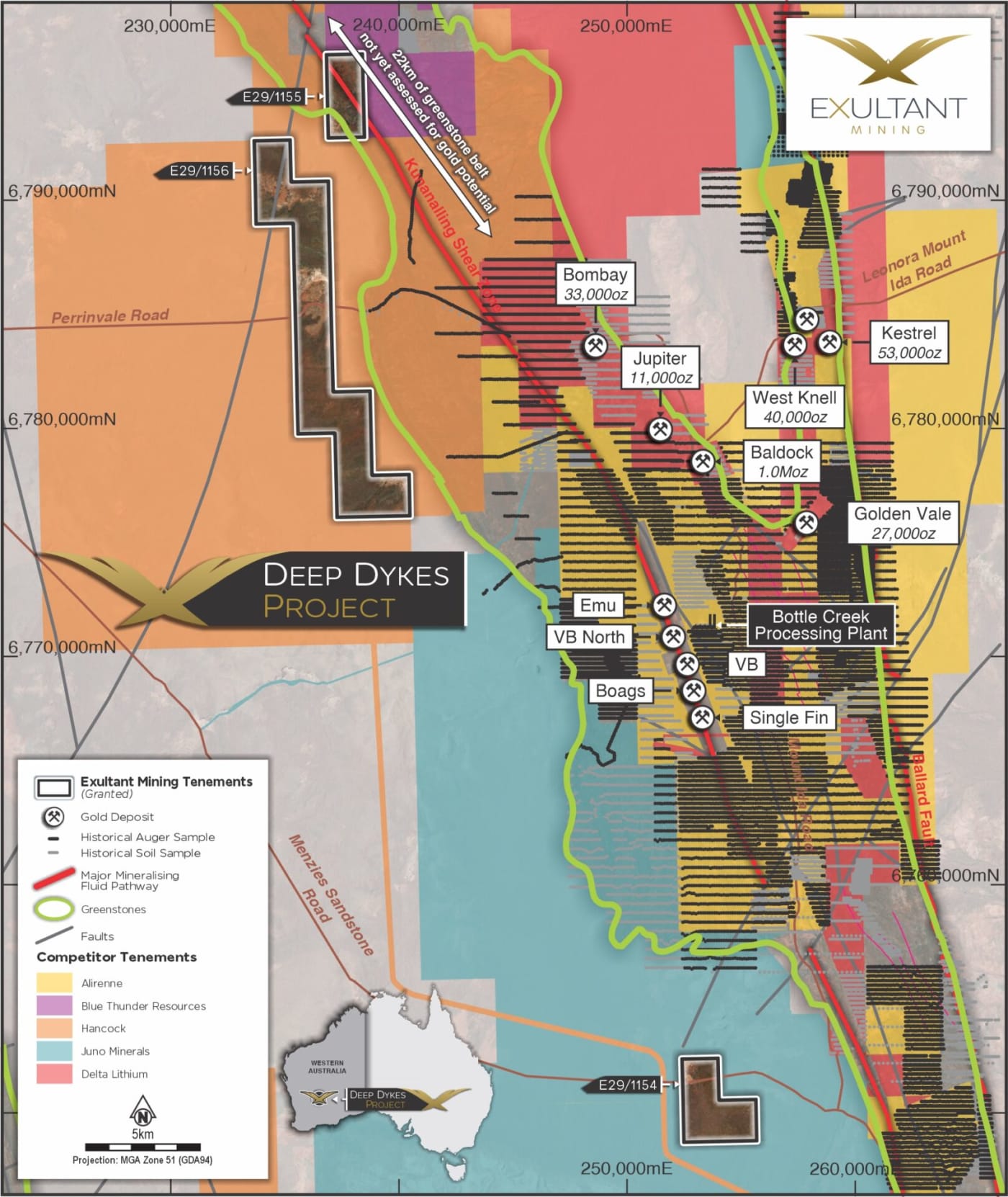
Project maps from Exultant Mining. Choose a project to zoom in.
Black Hammer, New South Wales.
~390 km² over three licences — Porters Retreat (EL9332), Tuglow (EL9826) and Swatchfield (EL9913) — 130 km west of Sydney and 30 km south of Oberon. The ground sits in the Ordovician Macquarie Arc, the belt that hosts Cadia Valley, Cowal and Northparkes. Nothing here has been drilled since 1998.
Porphyry, Skarn And Orogenic Gold In One Package
Black Hammer is deliberately early-stage and deliberately cheap to advance. The workflow runs mapping, then rock chip sampling, then portable XRF soils, then laboratory geochemistry, then geophysics, and only then drilling. Twelve prospects and historical workings have been identified across the project; three have been prioritised for the current cycle. Land access over the majority of the Watsons prospect has been secured and fieldwork commenced in September 2026.
Watsons
A copper-zinc soil corridor about 3 km long in the Rockley Volcanics, open to the north, associated with quartz-pyrite-chalcopyrite veining. It sits 2 km along strike from the Shooters Hill and Chatham Valley gold mines. It has never been assayed for gold and never been drilled.
Porters Retreat
Outcropping, strongly quartz-chlorite-albite-altered monzonite hosting pyrite and chalcopyrite. Litho-geochemistry indicates porphyry and epithermal Au-Cu fertility, angular alluvial gold occurs in the Retreat River, and basement magnetic anomalies suggest a larger buried intrusion. A historic sample from the prospect returned 12% Cu with 15 g/t Au. Never drilled.
Vermithor
A newly defined remanent magnetic bullseye roughly 1 km by 1 km, with the strongest core about 1.2 km long and deep, near the contact with the Carboniferous Isabella Granite and less than 5 km from the Footrot Au-Cu prospect. It has never been followed up by anyone.
Tuglow
Three historic copper mines over more than 1 km of combined strike. In July 2026 we re-sampled 1974 diamond core held at the WB Clarke Geoscience Centre, testing quartz veining that earlier explorers had written off as barren. TDDH1 returned 21.1 m @ 0.18 g/t Au and 2.1 g/t Ag from 3.4 m, including 4.5 m @ 0.26 g/t Au and 4.7 g/t Ag from 20 m. TDDH2 returned 0.2 m @ 1.7% Cu from 54.1 m.
Peak View, New South Wales.
~150 km² over EL9411 and EL8931, 35 km north-east of Cooma in the Lachlan Fold Belt. The host is a Silurian felsic volcanic package of the Yalmy Group, and the model is volcanogenic massive sulphide: the same style, and the same structural corridor, as the Captains Flat mine 50 km along strike on the Narongo Fault.
Balerion
Balerion is where the ground position becomes a drill target. A 900 m coincident Cu-Pb-Zn-Ag-Au soil anomaly, four discrete induced-polarisation targets and a 1.1 km gravity high were defined before a rig moved. Six holes for 1,370.3 m followed, returning visible sulphide in five of the six and mineralisation more than 200 m down-dip of the historical high-grade intercepts. Known VMS mineralisation at Peak View extends over 1.3 km and remains open along strike.
Maiden Drill Program · Balerion
Assay results for BLRCDD001, BLRCDD002 and BLRC003 were reported to the ASX on 13 August 2026, and for BLRCDD004, BLRCDD005 and BLRCDD006 on 1 October 2026. Visual observations for BLRCDD004 and BLRCDD005 were reported on 13 August 2026 and for BLRCDD006 on 26 August 2026. Visual estimates are not a proxy or substitute for laboratory analysis.
Four Ways Into The System.
Dipole-dipole induced polarisation across four 1.6 km lines, 136 stations of ground gravity on a 100 m grid, and a reprocessed 1994 airborne magnetic and radiometric survey. Together they define four targets at Balerion. Only one has any drilling near it.
Western Chargeability High
Roughly 700 m long, exceeding 12 msec with local coincident resistivity highs, strengthening to the north and open. It sits west of every historical drill hole and has never been tested. For calibration: the known historic high-grade mineralisation here returns only a weak response of around 8 msec.
Under The Soil Anomaly
A coincident chargeability and resistivity high of up to 18 msec and 4,900 Ωm, directly beneath the widest part of the 900 m soil anomaly and open to the south. Never tested. The historic hole PVI010 was drilled within 40 m of it and returned 1.3 m @ 3.4% Zn, 1.4% Pb, 21 g/t Ag and 0.14% Cu from 106.1 m.
Down-Dip Resistivity Low
A resistivity low positioned down-dip of the known massive sulphide mineralisation, consistent with the conductive response expected from a sulphide accumulation continuing at depth.
Sediment-Granite Contact
A chargeability high developed on the sediment-granite contact to the east of the main zone, a setting that can host contact-style mineralisation in this district.
A 1.1 km gravity high sits coincident with the western chargeability anomaly, suggesting potential for sulphide accumulation or dense alteration. A separate gravity low of about 1 km sits directly over the ground most previous explorers chose to drill.
Three More Prospects On The Same Ground.
Deep Dykes.
~100 km² over E29/1154, E29/1155 and E29/1156, with an application over E30/590 at Mt Hope, roughly 100 km north-west of Menzies in the Eastern Goldfields. The ground sits on the Archean Mt Ida-Ularring greenstone belt, along strike from Bottle Creek, and carries mafic-ultramafic sequences, banded iron formation and proximity to the Ida Fault Zone.
22 km Of Greenstone With No Recorded Sampling
Regional datasets reviewed by the Company show no recorded surface sampling across the tenure, over what it describes as 22 km of prospective greenstone belt. Historical surface work in the area returned up to 1.0 g/t Au in lag. Deep Dykes is the least advanced of the three projects by design: it is held cheaply, it is being worked up by desktop study first, and fieldwork is intended to begin in the fourth quarter of 2026.
One Corridor
At A Time.
Assays for BLRCDD004, BLRCDD005 and BLRCDD006 were reported to the ASX on 1 October 2026 and are being integrated with the drilling, geological, geochemical and geophysical datasets into an updated model for Balerion, and that model sets the next phase of exploration. In parallel, Watsons is being advanced at Black Hammer and Deep Dykes moves to fieldwork.
Sulphide abundances described for BLRCDD004, BLRCDD005 and BLRCDD006 are visual estimates recorded during core logging. Visual estimates are qualitative and should never be considered a proxy or substitute for laboratory analysis. Laboratory assays are required to determine the widths and grades of any mineralisation reported in visual observations, and assays for these three holes were reported to the ASX on 1 October 2026. Reported intervals for BLRCDD001 and BLRCDD002 include intervals of core loss which were retained in the reported widths and assigned zero grade in the length-weighted composites.
Exultant Mining has not estimated a Mineral Resource or an Exploration Target on any of its projects and insufficient exploration has been completed to do so. There is no certainty that further exploration will result in the estimation of a Mineral Resource. Historical drilling, production, resource and exploration results attributed to third parties — including historic drill results at Balerion and Footrot, the historic Porters Retreat and Tuglow sample results, and production or resource figures quoted for Captains Flat, Woodlawn, Cadia Valley, Cowal, Northparkes, Bottle Creek, Mt Ida, Marda, Shooters Hill, Chatham Valley and Lucky Draw — were not reported by Exultant Mining, have not been independently verified by the Company, and are provided as regional geological context only. They are not indicative of the mineralisation that may be present on the Company's tenements, and it should not be assumed that similar results will be obtained.
The Company's reported land position comprises granted exploration licences together with licence applications that remain subject to grant. There is no guarantee that outstanding applications will be granted in whole or in part, and the reported area may change as the application process progresses. Project areas quoted on this page are approximate. Statements regarding planned exploration, target quality, the expected timing of assay results and future activity are forward-looking and are subject to risks and uncertainties, many outside the Company's control; actual results may differ materially. This page is general information only and is not financial product advice. Investors should read the Company's ASX announcements in full.